


The Greatest Video Game Flops #2: Jack the Giantkiller by Cinematronics


When you think a 1970’s Silicon Valley tech company founder you might visualize a thin nerdy male wearing glasses with a degree out of MIT. Perhaps in your head you picture a Bill Gates type, or Steve Jobs type, maybe even one of the characters portrayed in the film Revenge of the Nerds. What you probably wouldn’t visualize were the two founders of the arcade game manufacturer Cinematronics who were more of a dead ringer for the jock bad guys from Revenge of the Nerds; Dennis Partee and Gary Garrison.
Dennis and Gary were not MIT alumni but former professional NFL Football players for the San Diego Chargers (now, the Los Angeles Chargers) in the 1970’s. Both men saw an opportunity with the popularity of Atari’s Pong released in 1972 and decided to start their own video game company on April Fool’s Day of 1975. The two former pig skin players then recruited Jim Pierce to act as company president soon after the initial founding.
Cinematronics’ first gaming offering in 1976 was Flipper Ball, best described as a mix between Pong, Breakout, and pinball machine themes. Despite including an actual house door bell for sound effects, the game sold poorly and surviving examples are rare today. For 1977 Cinematronics offered Embargo; an early “light cycle” style game (think Tron) in a similar vein to Atari’s Dominos or Gremlin’s Blockade. Surviving examples of this title are practically non-existent. Gary Garrison would sell his ownership in the company soon after the release of Embargo and the company seemed to have a bleak future outlook.
Things turned around dramatically for the company at the end of 1977 thanks to a partnership with game designer Larry Rosenthal and the release of his breakthrough game Space Wars. Similar to previous attempts to translate the Spacewar! mainframe computer game (Computer Space by Nutting was similar), this classic space combat game included several firsts in gaming; including the first arcade game to use a vector monitor, allowing for more precise wire frame style graphics. The number of customizable play options also proved to be popular with players. The game cabinet itself is larger than most of the era and commanding presence, almost like the monolith from the film 2001: A Space Odyssey.

By 1978 Cinematronics had sold 7,000-10,000 copies (depending on the source) of Space Wars and Cinematronics seemed to be poised to become a major player in the early arcade video game market. The success of Space Wars helped save the company from a potential financial black hole, recovering from previous marketplace flops. Rosenthal also received a royalty on each game sold, unheard of during this era of game development. This created a bit of a power struggle in the company resulting in Partee selling his stake to Thomas Stroud (a west coast coin-op operator). Rosenthal would also leave the company due to disagreements with management. He then created a new rival gaming company named Sunrise Research, known as Vectorbeam. Vectorbeam even put its own version of Space Wars into production.
With Rosenthal leaving Cinematronics he grabbed the technical documentation developed for Space Wars to re-create vector games on his own on his way out the door. Both companies attempted to play nice and work together despite the separation. This partnership was shaky at best, with Cinematronics retaining Rosenthal’s patents via a licensing agreement so they also continue to develop titles using the original Rosenthal's patents around vector graphics. Vectorbeam would manufacture it’s own games for a short time, many of these titles are interesting to collectors but had little presence in the marketplace overall.

All this drama however didn’t deter Cinematronics. They would develop several new titles including Starhawk in 1979, an early pseudo 3-D space shooter which was a success. In 1979 Rosenthal would sell his patents to Cinematronics and develop games for the company as Vectorbeam, became something of a subsidy of Cinematronics or think-tank. This resulted in a number of interesting and innovative titles including the early one-on-one fighter Warrior and the early 1st person space combat shooter Tailgunner. Rosenthal eventually would leave the company for good then sue Cinematronics for a dispute over royalty payments.
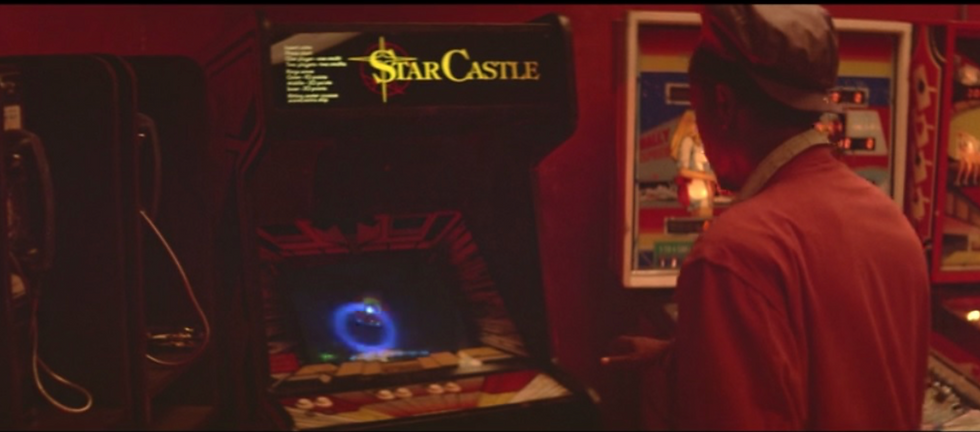
By 1980 Cinematronics was riding high thanks to the hit castle defense in space game Star Castle. Star Castle was so successful the licensed it to rival Rock-Ola due to manufacturing limitations. They also successfully sued Atari over using their vector graphics patents for Asteroids and Lunar Lander. By 1981 they had opened a new facility in order to upscale production but immediately started to struggle when they failed to come up with a title as successful as Star Castle. The overhead tank game Armor Attack sold well, but not as well as Star Castle had. A large amount of R&D funding to develop color vector technology for the title Boxing Bugs and a military contract to develop a tank simulator proved to be financial folly sending the company once more into financial hardship.

A plan was formulated to save the company from yet another bankruptcy, this was to license Japanese developed games for American distribution like other companies had done (Pac-Man licensed by Bally-Midway from Namco, Frogger licensed by Sega of America from Konami, etc.). But the market for gaming was competitive and constantly changing. By 1981 a new rival company had come out of nowhere with a innovative platform game which was stealing every last quarter from arcade players, that game was Nintendo’s Donkey Kong.
Every video game company wanted their own Donkey Kong and quickly scrambled to develop similar games or attempt to license them from overseas developers. Cinematronics bet on the old story of Jack and the Beanstalk as their way into separating kids from all those quarters. Jack the Giantkiller is a platform style title with gameplay practically lifted from Donkey Kong’s dynamics. The player controls the character of “Jack” who climbs and avoids objects in order to reach objectives on each level.

The hardware for Jack was developed by Hara Industries of Japan. Cinematronics reportedly spent 2 million dollars (adjusted for 2026, is is about 7.2 million dollars) to buy 5,000 motherboards from Hara. Keep in mind, this is just the hardware and not any developed game assets or as it turned out, any instructions on how to program the boards. If the game had sold 5,000 copies that would have put in in league with several decent successful games of the era, so Cinematronics was shooting for the moon here.
With no development tools or documentation, the Hara boards had to be reversed engineered by Cinematronics. Once released the game was met with mostly shrugs by players. It is fair to say Jack has little or none of the charm or polish of development of Nintendo’s classic Donkey Kong. It is not the worst of the many Donkey Kong copies but it has little to separate it from other titles from this era. By the time of Jack’s release in 1982 Nintendo had released Donkey Kong Junior, Atari had a slight success with the platformer Kangaroo licensed from Sun, and Taito’s Jungle King/Jungle Hunt also proved to be popular platformer style game. With such stiff competition a lackluster game such as Jack was doomed from the start.
The game is comprised of five levels in which you play Jack attempting to rescue the princess from the giant. Much like Donkey Kong, progressive rounds add additional levels of play, but the basic levels are described below:

The first level you simply climb vines, avoiding falling off to your death and along with getting out of the way of some little worm things. Here you can also collect beans along your vine journey to use as ammo later.

In level two, you walk among the “clouds” waiting for a drawbridge to open to cross. This level mostly deals with not falling off the clouds to your death.

Level three finds our hero in a very Donkey Kong like environment with some platforms and ladders, attempting to reach the top and grab the giant’s harp and avoiding various enemies and golden eggs. The giant is asleep at the top of the screen.

Level four is just level one again, but now descending the vines back to the ground. You also now avoid rocks presumably thrown by the giant. You only see the giant’s feet, so we assume he is awake now.

By round three another level is added which looks like an Atari 2600 version of Donkey Kong with some truly poorly drawn stairs and platforms in which Jack attempts to get to the sleeping giant (that giant is very sleepy) and avoid objects that look like barrels to me. Each completed level rewards Jack with a stolen treasure item. If a player completes 4 rounds of levels, Jack cuts down the tree and the giant falls down to his death and the princess is rescued. The game then shows a nicely rendered cut scene of Jack kissing the princess, who looks exactly like Jack in a dress.

The game is charitably described as clunky, a more truthful description would be half-assed. It has poor collision detection, uninteresting sound effects, the graphics are fairly ugly, and limited uninspired music. Since several of the levels revolve around just attempting to “not fall off the vines”, it becomes immensely frustrating to play. The game reminds me of many such platform freeware games for 8-bit computers of the era, that were not especially memorable or fun to play. The whole presentation is slapdash and amateurish.
Adding to the intrigue of Jack’s development is the odd decision to buy the Hara board sets with so little support for development, were accusations the deal for the boards was due to possible financial kick backs from Hara directly to Cinematronics employees. Then CEO Fred Fukumoto was the cheerleader and main visionary behind Jack and the Hara deal, leading many to question his motives and decision making. The game quickly earned the nick name “Jack the Company Killer”, with the once respected and successful company now having sub-standard products which no one wanted. No home versions of the game were ever licensed or manufactured which means Cinematronics missed out on another revenue stream for this unloved game.

There is also a bit of confusion of who exactly developed Jack the Giantkiller, was it Cinematronics developing on Hara’s hardware or did Hara develop the game in its entirety? In the July 15th 1982 issue of Playmeter magazine Cinematronics Executive Vice President Tom Stroud describes it as a licensed game. From the article:
The manufacturing firm released Solar Quest 1st October. Then something unusual happened: Cinematronics four months later released not one, but two licensed games- Naughty Boy and Jack the Giantkiller. The company produced more than one game at the same time.
Also in the same article, Tom Stroud stated:
Stroud wants everyone asking questions a bout Cinematronics to know the answers. No , Cinematronics has not stopped developing product. No, it is not going to manufacture licensed-only games. And the four month lapse between Solar Quest and Naughty Boy and Jack the Giantkiller was a slack time when no new product was being introduced.
Cinematronics attempted to regroup, offering a contest to win a golden egg, and a reworking of the title to Treasure Hunt with a slightly easier difficulty. This variant seems to have been distributed by Hara for outside the US markets. Some Hara boards were sold to other companies to attempt to recoup costs. None of this worked and Cinematronics was overrun buy unsold games. The follow up for this disaster was Naughty Boy, licensed by Jaleco from Japan. This bizarre overhead action game also proved to be unpopular with players and once again Cinematronics was heading to bankruptcy.

The company needed a hit quickly and in late 1982 they released the idiotically titled Zzyzzyxx licensed from Advanced Microcomputer Systems. This puzzle hybrid game was a colossal failure and surviving copies are rare today. In September of 1982 Cinematronics went into Chapter 11 bankruptcy protection. Cinematronics, refusing to die, would go onto next release a game that would change the industry, that game was Dragon’s Lair.
Dragon’s Lair was the first US wide released Laserdisc based game and would find instant success both in the press and in arcades thanks to it’s animated visuals. Despite the wide public interest of Dragon’s Lair it failed to stabilize the company form a financial standpoint. This was due to the Laserdisc system being unreliable, expensive to manufacture, Cinematronic’s inability to upscale production for demand, and that despite the popularity of crowds near the game… some players just wanted to watch others play and were not necessarily interested in paying the 50 cents (a first at the time) per play to give it a go.
The follow up for Dragon’s Lair; Space Ace featured more dynamic gameplay and more reliable tech but was not a financial success. Cinematronics continued to linger in the swamps of unprofitability. The Laserdisc gaming era came and went quickly as players grew tired of the limited gameplay dynamics of Laserdisc games. Cinematronics would leave vector and Laserdisc games behind and start developing traditional raster titles during an era of market downturn. They would eventually find success with a number of excellent sports titles including the baseball game World Series.
Cinematronics stayed in bankruptcy protection until 1987 (the longest such protection in Californian history) due to a buy out from Tradewest. The company was renamed Leland and would continue to develop games through the early 1990’s before finally becoming part of WMS (formally Williams Electronics) in 1994.
The legacy of Cinematronics is one of seemingly snatching defeat out of victory. Despite its early successes it was constantly derailed by mismanagement, poor product decisions, and questionable motives of its staff. Jack the Giantkiller is proof that even in 1982 players would not spend money on a me too product or any game of poor quality. The other night I re-watched the “so bad it’s good” classic film Maximum Overdrive. The only film directed by famous author Steven King who has admitted his decisions were (at the time) fueled by a combination of bravado, lack of insight and cocaine addiction. Bravado and lack of insight defiantly played a major role in the release of Jack the Giantkiller. As for the cocaine, well… it was the 80’s so who knows.
Next Time: Atari makes a game that pisses off operators so much they have to make an apology game


