The Greatest Video Game Flops #1: Intellivision Keyboard and Mattel Aquarius


"A computer once beat me at chess, but it was no match for me at kick boxing.” - Emo Philips
We will start this new sub series (which hopefully will be updated with a bit more regularity than my typical output) with one of the great classic flops of the early 1980’s, the Mattel Electronics Aquarius system. According to those who believe in pre destined personality traits of the zodiac, those born during the astrological sign of Aquarius are often seen as aloof. (1) Despite it’s status as a home computer (technically) in reality it was a downgraded Intellivision pushed into the world due to Mattel’s continued obsession and failure to bring a computer add on into the market for the Intellivision gaming console.Take a dive into the stars of disappointment!
In the Beginning
Let us go back and bask in Mattel’s Big Bang moment of toy creation. Mattel was founded by three people; investor Harold Matson along with husband and wife Ruth and Elliot Handel. Matson would sell his share of the company to the Handel family soon after Mattel’s founding due to heath issues in 1945, transforming Mattel strictly into a family affair.

First released in 1959, Mattel’s big break out product was the iconic Barbie fashion doll and all her many accessories. Mattel would continue to innovate and dominate the US toy market throughout the 1960’s with toys such as the Chatty Cathy doll, See ’n’ Say string pull toy, and the Hot Wheels miniature cars, which are still popular today with kids as well as adults. After these successes, in 1970’s Mattel decided what they really wanted to be was in the electronic music instrument business.
In 1971 Mattel released the Optigan piano through a newly created subsidy with the creative name: The Optigan Corporation. The Optigan was a pre-digital attempt at an organ or synthesizer which included pre-recorded tracks. These pre-recorded tracks allowed for people with little or no knowledge of piano to make music with simple one key operations. The organ used an optical storage device (which looks like a record) with a technique similar to how sound was transferred to motion picture film for theaters.

The piano itself sold for around 600-400 dollars depending on the model and accessories. Additional disks offered alternative instrumentation and musical genres allowing for different jams at your swinging cocktail parties. Sadly for Mattel, the Optigan proved to be a giant sales dud due to design and quality control issues. It was also a fairly limited device beyond that of a true amateur musician. As new early synthesizers arrived around the same era (such as the famous Moog) Opitgan became a product in which the stars were not aligned for its success.
With the failure of the Optigan, Mattel found themselves in major financial hot water. The company lost over 62 million dollars during 1972 and 1973 combined. Mattel was forced to sell some assets to stay afloat including their ownership of the Barnum & Bailey Circus, and dumping the practically worthless Optigan Company in June of 1973. (2). Mattel would also see the end of the Handel family rein due to an investigation over misleading financial reporting in 1974. (3)
These setbacks didn’t stop Mattel from pushing forward in the area of electronic entertainment. Transistors and simple integrated circuits were becoming cheaper and more powerful, Mattel sensed an opportunity of innovative play. Mattel stated selling a very popular line of handheld LED electronic games and toys by the late 70’s. Mattel’s Electronic Football was so popular it caused lines at toy stores during it’s first Christmas in 1977. (4) This lead up to the release of it’s own video game console system the Intellivision in 1979. Intellivision became the first real threat to the dominance of the Atari VCS/2600 thanks to its advanced graphics and sounds. Despite it’s controversial disc shaped controllers, the system was a success and by 1981 Mattel owned about 20% of the domestic home gaming market. Finally the outlook was looking good for Mattel’s electronic endeavors.
The Wild West of Silicon Valley
The large variety of choices of video game consoles and home computers during the early 1980’s could be confusing. You could by a game system from Mattel, Magnavox, Milton Bradley, Emerson, Bally, Coleco, two different models from Atari, or rebranded systems from Sears and Radio Shack. On the home computer side the choice was even more varied with few of these products having any compatibility. As a consumer, if you chose the wrong system you could be stuck with lame software, an obsolete system, or a lack of any future technical assistance.

In the US, Atari was one of the major players in home computers, arcade games, and the main player in home gaming. A lot of the success around Atari’s home systems was its library of arcade titles which could be released to it’s home products exclusively. Atari’s 8-Bit 400 and 800 computers were solid machines and very capable for the time period, producing decent home arcade game translations. Atari had both a more casual gaming market interest with the Atari VCS/2600 home system and home computers for the gamer with deeper pockets.

There was a lot written in the press during the early 1980’s that home gaming systems were perhaps a fad. Home computers were sold on their abilities (at least to parents) that they were more “serious” machines capable of doing much more than just playing games. Countless ads for computers of this time period show kids working on homework, Mom managing the family budget, and Dad working from home. Mattel perhaps feared if they didn’t have some sort of interest in the computer market the success of the Intellivision would have the future of the poor Optigan.
The Failure of the Keyboard
One of the early marketing promises to consumers of the Intellivision was a keyboard would be manufactured to expand the system into a home computer. Intellivision announced that the keyboard would be available by Christmas of 1980 for about $250. (5) The idea of an expandable platform which could grow with the family’s needs was appealing for many consumers. Intellivision’s advanced hardware seemed to be capable on a surface level to make this a realistic claim. Sadly for Mattel the keyboard expansion became a huge boondoggle which would hover over the Intellivision’s reputation during its entire existence.

Despite promises for the add-on, delays in its arrival become longer and longer to the irritation of Intellivision owners, investors, and Mattel management. The keyboard fiasco was so well known that during Mattel Electronics’ 1981 Christmas Party host comedian Jay Leno joked,
"You know what the three big lies are, don't you? 'The check is in the mail,' 'I'll still respect you in the morning,' and 'the Keyboard will be out in the spring.’”.
The add-on keyboard known as Intelliputer (also known internally as Blue Whale) was slated to initially have 16kb of RAM, a typical for the era cassette tape recorder for data recording and retrieval, and an additional processor to the Intellivision’s to assist with running everything smoothly. Having the keyboard would in theory allow for more sophisticated programs and interactions. Reliability concerns and manufacturing costs during development became a massive headache for Mattel engineers. The original release date of 1980 would be continually pushed back as Mattel attempted to overcome issues. The keyboard would eventually arrive in late 1981 (with some stores advertising it as far back as the holiday of 1980) although only through mail order only and select retail store locations.

The computer add-on quickly became a financial a PR nightmare for Mattel as well. By 1982 the US Federal Trade Commission (due to consumer complaints) started fining Mattel 10,000 dollars per day until the keyboard was widely available to consumers. For those who actually got their hands on one, the response was mostly of disappointment over its clunky design, reliability issues, and lack of useful software.
By 1982 the computer price war was becoming a real battlefield with competing company’s products slashing prices to gain market share. For the price of Intellivision’s keyboard add-on ($699.99 plus the cost of the Intellivision) any number of superior home computers could be had with enough money left over for accessories. Only around 4,000 keyboard component add-ons were made in total, compared to the millions of Intellivision’s sold during its lifespan. To add insult to injury, Compro who was outsourced to manufacture the keyboards for Mattel would sue due to breach of contract over lack of payment. (6)

Mattel had a back up plan, and in 1983 with the release of the redesigned Intellivision (named Intellivision II) came the Entertainment Computer System or ECS add-on. The ECS was a small plug in keyboard which lacked any of the real usability originally promised with the first keyboard add-on. ECS was named internally at Mattel as LUCKI which stood for "Low User-Cost Keyboard Interface” giving us a clue on Mattel’s motivations here. Whoever bought this was far from “LUCKI” since it offered a pathetic 2kB, no secondary CPU, a terrible feeling keyboard, and a very basic cassette recorder and printer interface. It did have BASIC built in along with improved audio capabilities. (7) From Mattel’s perspective this fulfilled the original promise of a keyboard add-on which they hoped would satisfy consumers and stop the fines from the US FTC. Officially only six software packages for the ECS would be released. Mattel apparently eager to get back into the music business, released a piano keyboard add-on as well. Only one software title would be released for the piano add-on.
The Dimming of the Age of Aquarius
In 1983, the hyper crowded computer and video game console marketplace was in the middle of a price war and by all accounts heading for a disaster. Mattel felt this was the perfect moment to announce an all new home computer system. Learning nothing from attempting to turn the Intellivision into a computer, Mattel felt what they really needed to do was release a mediocre home computer. This idea fostered into a product which was neither compatible or superior than the Intellivision.

The computer known as Aquarius was developed by the Hong Kong company Radofin who handled most of Mattel’s manufacturing duties for the Intellivision along with producing its own video game systems for sale outside of the US. Radofin had developed two computers around the classic and very capable Zilog 80 processor which they codenamed “Checkers”, a low cost version and “Chess” a better more feature rich computer. Mattel went with the less powerful machine and Checkers became Aquarius.
The computer has many faults and was massively outclassed by the competition. Let’s list the major ones out
The keyboard is a terrible rubberized flat chiclet design which makes any kind of accurate or fast typing impossible
The keyboard also had no space bar, just a standard button on the left side of the Z key
Aquarius’ standard 4K was barely enough to do anything. Only 1.7K was useable after BASIC loaded.
The system pretty much required the add on memory model or the “Mini-Expander” which added two Intellivision like controllers for gaming to play any software.
Has no programmable graphics or sprites, all graphics are made up from a set of pre defined character set which are very basic. (Think Wingdings) Mattel’s Intellivision gaming system can run rings around the computer in terms of graphics and sounds.
The computer was limited in it’s initial expansion due to a lack of a standard printer port or any ability to hook up a disk drive. This included not having the ability to hook up to a proper monitor, only to a television set.
Mattel’s engineers knew that Aquarius was a giant failure of a machine, dubbing it “.. the system for the seventies”! The basic computer originally retailed for about 160 dollars. This included the computer, an AC power adapter, and the cables needed to connect it to a television. From my internet digging it seems it was selling at most stores (they few that carried it) for about 120 dollars for the computer, 50 bucks for the Mini-Expander, 50 for the tape.. uh a mean Data Recorder, 150 for the tiny thermal printer, and software ran about 20 to 80 dollars.

Burger Time for the Aquarius

Burger Time for the Intellivision
Comparing a well known Intellivision game title also made for Aquarius; Burger Time, shows just how limited in capability the Aquarius was. Burger Time on the Intellivision presents fun colorful sprites, music, sounds, and animation. It is a very good translation of the original arcade game by Bally-Midway and immensely playable. The Aquarius version de-evolves into a clunky mess made from ASCII like animated characters. Animations are jerky, well known Burger Time characters such as Mr. Pickle, Mr. Hot Dog, and your Chef are unrecognizable. The game also lags making it a chore to play compared to the Intellivision version.
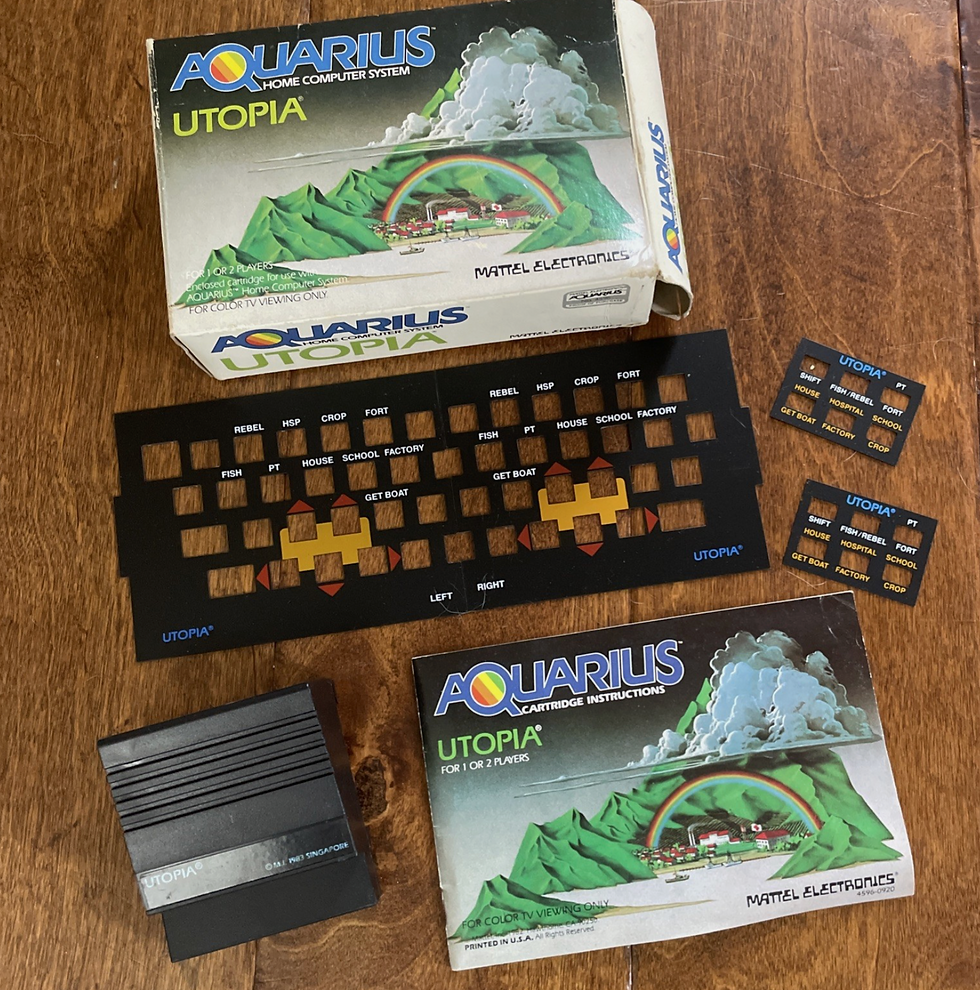
The system was an immediate flop in the press and with the public. Outclassed by other computers which were more powerful and had robust user bases, the Aquarius didn’t stand a chance. For comparison sakes in 1983 you could buy either an Atari 400 (16K but also included a terrible keyboard), or a Commodore VIC-20 (which was also somewhat underpowered but at least had a decent keyboard). For a few dollars more you could get a more powerful Commodore 64 or Atari 800. Any of these models had vastly more software and support than the doomed Aquarius. By the end of 1983 thanks to a price war Aquarius didn’t have a chance. The far superior Atari 400 and VIC-20 were being advertised for under 100 dollars (or 100 smackers if you prefer) undercutting the Aquarius even on price.

If you had bought an Aquarius you probably felt someone smacked you in the face and stole your money. After a whopping four months on the market Mattel took the Aquarius out back of the barn of Mattel HQ and put it out of its misery. Unsold product was bundled together and sold at a deep discount at outlet stores and via mail order to unsuspecting computing noobs or suckers. There is a reason so many vintage Aquarius’ (Aquiri?) for sale on EBay look new in the box, they likely were bought on a discount by customers whom soon discovered how limiting they were and moved onto greener Silicon Valley pastures.
Aquarius II: Time For One More Mistake
Strangely this wasn’t the end of the Aquarius computer. Radofin would buy the rights of the computer back from Mattel, re-releasing it under their own name and eventually bringing out the upgraded Aquarius II model (“Chess”) in 1984. These seem to have mostly been sold in Europe and in limited quantities with the Aquarius II model being especially rare today. The Aquarius II did include a true full travel keyboard, still included the on-board 4K as standard, but did come with Extended Microsoft Basic and memory add-on cartridge as an upgrade. Already woefully outclassed by the summer of 1985 even more powerful competition arrived, such as the 16-bit Atari ST and Amiga just to add insult to injury.

It’s All Over But the Crying
Mattel essentially shot themselves in the foot three times with the failure of two ill conceived computer keyboard add-on for Intellivision and the catastrophically bad Aquarius. It’s hard to say if it was Mattel’s bravado, jealously of Atari (or other home computer makers), or just not fully understanding the home computer market which most factored into these terrible decisions. There were outside factors as well. The overall market crash around 1983 for the home computer and home game markets in the USA helped drag Mattel and many other companies into a financial death spiral. By late 1983 Mattel was still reporting to the press they had no intention of getting out of the home electronics entertainment business, but by early 1984 Mattel Electronics along with the once widely praised Intellivision was officially dead.

Mattel lost 283.5 million dollars for the first nine months of the fiscal year of 1983 in their electronics division alone. (8) This forced Mattel to again to sell assets to stay afloat (this time, an amusement park they owned) along with laying off major amounts of staff. Plans for a new advanced gaming system (both an Intellivision III and IV were in the works) were permanently cancelled. Remaining Intellivision products were sold at a deep discount with the rights to the system eventually being purchased by a group of former Intellivision employees. This new company, INTV Corporation would continue to support the system and release some new games until 1990. INTV even released a new Intellivision model dubbed the INTV System III, which was just a slightly cosmetically changed version of the original Intellivision model.
Intellivision was an important game system in the hallowed halls of gaming history. It’s advanced graphics, sounds, and licensed sports titles were a huge leap into more realistic gaming. Mattel also helped shaped handheld gaming with its early LED portable games. If Mattel had not attempted to get into the computer business they might have survived the downturn in the market in 1983 and gone onto release more powerful systems, but unfortunately it just wasn’t in the stars for Mattel.
Cassandra: The Vintage Arcade Gal
Next Time: An arcade manufacturer founded by two pro football players decide to make a terrible Donkey Kong competitor which no one plays.
(1) Vucinic, I. The Aquarius Zodiac Sign: Complete Aquarius Horoscope. zodiacsign.com. May 1, 2026.
(2) Mattel Sales. The Los Angeles Times. February 20, 1974. Page 72
(3) Mattel Reveals Profit Report Was Padded. The Los Angeles Times. October 3, 1974. Page 62
(4) Zito, T. Games Run By Little Computers Produce Big Profits for Toy Makers. Columbia Daily Tribune. November 23, 1977. Page 44.
(5) Smith. J. Yes You Can Talk Back To Your Television. The Hamilton Spectator. September 13, 1979. Page 37
(6) Keyboard Component. Development History. https://history.blueskyrangers.com/hardware/keyboardcomponent.html
(7) Blanchet, M. New Mattel Computer System. The Buffalo News. March 6, 1983, Page 99
(8) Storch, C. Mattel to Quit Home-Video Field. Bryan-College Station Eagle. February 4, 1984. Page 33